If you follow me on Twitter, you most likely have seen a
fair few tweets about cognates (and if you don’t follow me on Twitter, you’re a
terrible human being). As much entertainment as I find in cognates, I neglected
to explain what they are – until now.
Before getting into the nitty-gritty of what they are, a
little etymology to get us in the right theme. Cognate is a Latin borrowing, from cognātus, meaning 'related by blood'. It, in turn, is derived from cum ("with") and nātus ("born"). (The <g> comes from an earlier form of nātus, gnātus, from gnāscor, to be born - itself a distant cognate of English kin - shit, I'm talking about cognates without explaining, we'll circle back!)
That was a bit recursive. So cognate literally is something that is blood-related. When it comes to words, blood is a bit harder to draw, but nonetheless familial relationships can be not only be drawn, but fully mapped to create enormous trees of related words, and similarly, related languages (we'll save the related languages for later).
Running off of that etymology, cognates are words were born of the same source. One of the best places to look for cognates is the Romance languages, mainly because they all have a well-documented mother language (Latin) and just happen to be overflowing with cognates (so I guess you don't have to look too much). Let's look at Spanish and French, and Latin:
miel, miel, mel (honey)
luna, lune, luna (moon)
cabra, chèvre, capra (goat)
ocho, huit, octō (eight)
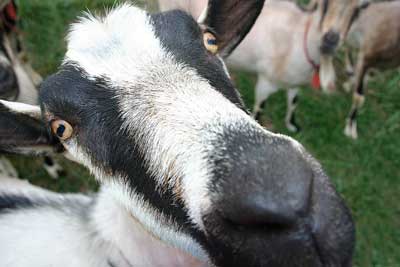 |
| "I prefer Romanian capră." |
Some of these show a very clear relationship to each other (such as miel, which is pronounced almost identically in both Spanish and French). Others don't seem like they're related until you look at the Latin (and squint a little), such as cabra and chèvre.
Cognates don't necessarily need to be in different languages, either. English is rife with cognates within itself, such as warranty and guarantee. Both come from Old Frankish (an extinct language that Old French borrowed from now and then), but warranty comes from Anglo-Norman, a French dialect that developed in England, while guarantee comes from mainland Old French. Shirt and skirt are cognates, too. Shirt is native English and comes from an old Germanic word for some form of clothing (most likely a long upper-body garment), while skirt is a borrowing from Old Norse (Vikings!) that developed from the same source.
BUT WAIT. ALERT ALERT! Borrowing? We all know languages borrow from each other (that's why robot is the same in a large amount of languages, it was borrowed), but when does a borrowing become a cognate? Cognates imply change - shirt and skirt are both descendants of older words that originated from the same older word, although one was borrowed into English.
Yes, this means that every high school Spanish teacher is wrong. Pizza is not a cognate to English pizza. (It's an Italian borrowing, though it's more likely that Spanish borrowed the word from English, indirectly from Italian.)
 |
| Giving something doesn't mean it's a gift. |
Hopefully now my tweets will get a bit more appreciation. Cognates can be good fun, especially when they are riddled with irony.
Another good pair (though not as entertaining)? English whore and the French endearing term cherie (like Steve Wonder's My Cherie Amour). Both are rooted in the Proto-Indo-European root meaning "loved". I guess you can love your whore.
