Linguistics with a dash of non-textbook style humor.

Monday, November 12, 2012

The Gift of Gift (and Other Cognates)


If you follow me on Twitter, you most likely have seen a fair few tweets about cognates (and if you don’t follow me on Twitter, you’re a terrible human being). As much entertainment as I find in cognates, I neglected to explain what they are – until now.

Before getting into the nitty-gritty of what they are, a little etymology to get us in the right theme. Cognate is a Latin borrowing, from cognātus, meaning 'related by blood'. It, in turn, is derived from cum ("with") and  nātus ("born"). (The <g> comes from an earlier form of nātus, gnātus, from gnāscor, to be born - itself a distant cognate of English kin - shit, I'm talking about cognates without explaining, we'll circle back!)

That was a bit recursive. So cognate literally is something that is blood-related. When it comes to words, blood is a bit harder to draw, but nonetheless familial relationships can be not only be drawn, but fully mapped to create enormous trees of related words, and similarly, related languages (we'll save the related languages for later).

Running off of that etymology, cognates are words were born of the same source. One of the best places to look for cognates is the Romance languages, mainly because they all have a well-documented mother language (Latin) and just happen to be overflowing with cognates (so I guess you don't have to look too much). Let's look at Spanish and French, and Latin:

miel, miel, mel (honey)
luna, lune, luna (moon)
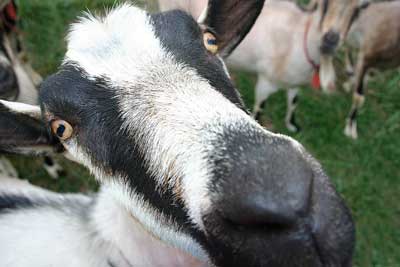
cabra, chèvre, capra (goat)
ocho, huit, octō (eight)

"I prefer Romanian capră."
Some of these show a very clear relationship to each other (such as miel, which is pronounced almost identically in both Spanish and French). Others don't seem like they're related until you look at the Latin (and squint a little), such as cabra and chèvre.

Cognates don't necessarily need to be in different languages, either. English is rife with cognates within itself, such as warranty and guarantee. Both come from Old Frankish (an extinct language that Old French borrowed from now and then), but warranty comes from Anglo-Norman, a French dialect that developed in England, while guarantee comes from mainland Old French. Shirt and skirt are cognates, too. Shirt is native English and comes from an old Germanic word for some form of clothing (most likely a long upper-body garment), while skirt is a borrowing from Old Norse (Vikings!) that developed from the same source.

BUT WAIT. ALERT ALERT! Borrowing? We all know languages borrow from each other (that's why robot is the same in a large amount of languages, it was borrowed), but when does a borrowing become a cognate? Cognates imply change - shirt and skirt are both descendants of older words that originated from the same older word, although one was borrowed into English.

Yes, this means that every high school Spanish teacher is wrong. Pizza is not a cognate to English pizza. (It's an Italian borrowing, though it's more likely that Spanish borrowed the word from English, indirectly from Italian.)

Giving something doesn't
mean it's a gift.
Another fun thing about cognates is that they don't necessarily have to mean the same thing. After spending time in a language, words have a tendency to change meanings. It doesn't happen all of the time (cow, for example, has had the same meaning for thousands of years, even though it has undergone massive pronunciation changes), but in other cases a word can shift dramatically. A fantastic example is the word gift and Gift, in English in German. They are very, very similarly pronounced, are complete cognates (both derived from the old form of the word give), but their meanings have diverged to a point of accidental linguistic irony - Gift is German for "poison".

Hopefully now my tweets will get a bit more appreciation. Cognates can be good fun, especially when they are riddled with irony.

Another good pair (though not as entertaining)? English whore and the French endearing term cherie (like Steve Wonder's My Cherie Amour). Both are rooted in the Proto-Indo-European root meaning "loved". I guess you can love your whore.

Monday, April 11, 2011

Lëärn Tö Ümläüt

I'm sure all of you have seen those foreign looking dots over words of German origin, or at least seen them on the names of numerous metal bands (Blue Öyster Cult, Motörhead, Mötley Crüe, Maxïmo, Infernäl Mäjesty, and possibly the worst, Spın̈al Tap). This is this eponymous umlaut.

The actual name for those dots is a dieresis, which comes from Ancient Greek διαίρεσις, meaning 'split'. And that's just what a dieresis normally does. You may have seen words such as naïve and Noël before - they are imports from French, where normally the orthographic vowels would represent diphthongs (a diphthong is when two vowels make up one syllable, like the English word I - it's a combination of two vowels, the first is sound of the <o> in mop, the second is the <i> in bin). We pronounce naïve and Noël, in IPA, as /na.iv/ and /no.ɛl/, because the dieresis tells us to split up the vowels.

From e's to ̈
So what the hell does this have to do with Blue Öyster Cult? German, through its linguistic evolution, had some changes in its vowels. It's nothing unusual, English did as well (look up the Great Vowel Shift to see how all the English vowels went berserk in the 1300s or so), but German decided to mark the newly-formed vowels since they were unlike the already existing ones. The German scribes took to putting a small, tiny <e> over the vowels in question - a, o, and u. This miniscule e degraded into a pair of lines, until final it emerged as just two dots over those three vowels, yielding ä, ö, and ü. (Fun fact: this process occurred in English too, but we never added the dots, and the new sounds ended up disappearing anyway).

Now, the Germans didn't just arbitrarily add some polka-dots to three vowels for ornamentation, these new letters where represented three new sounds that hadn't previously existed before. They had been fronted. Fronted? Yes, fronted.

Charts are great for watching vowels go haywire
Vowels are (as we know) pronounced in the oral cavity, AKA, the mouth. The way a vowel sounds depends on three main factors - how high/low the tongue is (in comparison to the roof of the mouth), how far front/back the tongue is (in comparison to the back of the mouth), and whether or not the lips are rounded (forming a circle) or unrounded (in a more... normal position). If we look at our handy-dandy chart of vowels, you'll see that they are plotted in accordance - the left is the front of the mouth (near the teeth), the right is the back (near the throat), the top is... well, the top, and same for the bottom. And as that chart says, vowels in pairs (like /i/ and /y/) are respectively unrounded and rounded.

The three German vowels that were affected were back vowels - /o/, /u/, and /ɑ/. Through a process called assimilation, or also confusingly called umlaut (not really confusingly, but it can be confusing when the phenomenon and diacritic have the same damn name), the vowels moved forward in the mouth (retaining their roundedness) because a vowel that followed them in the next syllable was also in the front (normally /i/). The first vowel assimilated, AKA got more similar, to the following one in an effort to ease pronunciation - the tongue gets to stay in the front for the whole word. In this change, /o/, /u/, and /ɑ/ became (respectively) /ø/, /y/, and /ɛ/ in modern German (by technicality, /ɛ/ is both raising and fronting, but I'm trying not to split hairs).

So then... why am I describing this phenomenon? Because I fucking hate the heavy metal umlaut, as it is called. I really do. It's there for decoration, and as far as I am concerned, umlauts should be used for pronunciation. That is also why I HATE Spın̈al Tap's name - you can't umlaut a fucking n, it's not even a vowel!

Don't even get me going on faux Cyrillic.

Friday, March 25, 2011

¿Espik espanich?

Much to the chagrin of many crazed patriotic Americans, there are Spanish speakers here in the United States. And no, I'm not alleging that English be made official language (instead of its current de facto status). Instead, we're going to explore why Spanish speakers can't say the word 'speak' and why the French have a hard time with 'the'.

If you read my last post (and if you didn't, you better fucking read it), you have some idea of what IPA is. Today we're going to work on what those symbols in IPA actually stand for - sounds. One of the fundamental concepts of linguistics that was drilled into my head by one of my absolute favorite professors is this: a letter is not a sound, and a sound is not a letter. I'm betting that you're now asking yourself, "what the hell does that mean?", but sit tight. It's actually simple.

A letter is simply a graphic realization of a sound. That is to say, a letter represents a sound, just like how a clock represents time or how a music note represents a note - clocks aren't actual time, and music notes aren't actual music. They are simply representations. This holds just as true for letters of an alphabet (like our Latin alphabet) or the letters of the IPA (though IPA is a bit handier because, unlike our English version of the Latin alphabet, each letter only has one sound associated with it, unlike English with the letter <a> having at least three - and that's without me thinking hard about how many it actually can represent).

That being said, we can get into some more linguistics and explain why English is difficult to pronounce for other language speakers (or why we have trouble with other languages). Now, if you glanced at the IPA chart of consonants in the last post (if not, click here for a chart with audio samples), you'll see that there are a ton of them (59 on that chart alone, and that's without any co-articulated consonants, affricates, or non-pulmonics). No language uses every single consonant. Most languages only use a fraction - English has around 21 (if I'm not mistaken), Spanish has 17 (18 for peninsular Spanish), and some languages like Ubykh (which is extinct as of 1992) had 80 (I am counting consonants phonemically, not phonetically - I'll explain that in a bit).

So what does that mean? If Spanish has 17 consonants, French has 20, and English has 21, that means that the three of them obviously do not share all the same consonants. Some are shared between all three, like /p/, /d/, /t/, /d/, /k/, /g/, /m/, /n/, and /j/ (these are written in IPA - the first 8 are virtually identical to the English sounds associated with those letters, the last one /j/ is the sound that <y> makes in English, like 'yellow' - check out that interactive consonant chart I linked above for more examples of IPA consonants and their represented sounds). Others however, exist only in some. English is the only one to have /θ/ (the <th> sound in 'thin'), Spanish is the only one with /x/ (the sound that 'loch' ends in for a Scottish speaker, or German 'ACH!'), while French is the only one with /ɥ/ (this sound is non-existent in English, but it's like a /j/ with your lips rounded).

Now to elaborate on what I said earlier, about these being phonemic consonants, not phonetic consonants. If a sound is phonemic, that means it determines meaning - for example, the words 'lad' and 'bad' are clearly different in their initial sounds. And as English speakers, we know that these are two separate words to us because the initial sounds are both phonemic in English. If we were to switch the <l> for an <s>, we would have 'sad', yet another different word with a different meaning. In this, we've proved that the sounds [l], [b], and [s] are phonemic in English. (for the sake of simplicity, I'm going to dodge around why I used brackets there and not slashes - phones (actual sounds) get brackets, while phonemes get slashes - I know, confusing for now).

Believe it or not, we actually have way more sounds in English than you'd expect. For example, the phoneme /t/ is pronounced differently depending on where it is - if it starts a word or a syllable with stress, it's [tʰ] (like 'tap'); if it comes after an [s] that starts a syllable, it's [t] (like 'stop'); for American English, if it comes between two vowels and after a stressed syllable, it's [ɾ] (like 'atom'); and if it starts an unstressed syllable and precedes a nasal, it's [ʔ] (like 'button'). Those are 4 different sounds, but as English speakers, we all interpret them as a /t/. Those are called allophones, and they are sounds that are different but interpreted as the same phoneme. They don't contrast meaning like phonemes do - if you switch one allophone of a phoneme for another, you'll sound funny, but be totally understandable. So transcribing sounds phonemically, we're talking about the contrasting sounds of a language (these transcriptions get slashes, //), while phonetically means the actual sounds produced, allophones and all (these get brackets []). I know it's a bit confusing, but we'll work to disambiguate more in future posts.

I know it's been long-winded, but that is why the French have a hard time with the 'th' sounds in English - they aren't in the phonemic inventory of the French language, and therefore they never use the sounds. This is the same reason why English speakers have a hard time with German - we don't have /x/, but German does.

Now then, why the hell do Spanish speakers (at least, before they have had the time to learn English well) say things like 'Espik espanich?' for 'Speak Spanish?'. Two reasons. One, much like the French, they lack certain sounds in their phonemic inventory that English's inventory has, like /ʃ/ (the sound represented by <sh>, like in 'ship'). The second one brings us to the wonder of phonotactics.

Phonotactics are the rules for combining phonemes in a language. There are rules for how sounds can be put together to make a word. For example, 'pflegen' does not look like an English word, because we don't allow the cluster [pfl] to start a syllable (it's actually German, and means 'to care for'). For Spanish, [s] + a consonant cannot start a syllable. That simple. So the simple (or simple in our perspective) cluster [sp] is just difficult for Spanish speakers, so they throw in an extra vowel (the epenthetic vowel for Spanish, [e]) to make it pronounceable for them.

Phonotactics govern how a language often sounds - Japanese and Hawaiian don't allow any consonants to come together (though Japanese does allow /n/ to precede consonants, but that's it), producing words like Japanese 'anata' ('you') and Hawaiian 'kanaka' ('person'). Meanwhile, the Slavic languages are known for large consonant clusters, like Polish 'wstrząs' ('shock'), which starts with [fstʂ].

So, ze French speak like zat, and the Spanich espeakers espeak like that because their phonemic inventories and phonotactics don't match up with those of English.
Friday, March 18, 2011

WTF with IPA

IPA excites me. Not India Pale Ale (though liquor in general does make me rather joyous), but the International Phonetic Alphabet. To the average English major, IPA is sheer and utter hell. I, however, find IPA to be borderline orgasmic.

Before we get into the nitty-gritty of it, pop over to the Wikipedia page on IPA. Yes, I realize that it is long and winding and full of subsections. And no, we're not going to cover everything in that article. I just wanted to show you that it's important enough to have a big Wikipedia article, and that it's more important than India Pale Ale because wikipedia.org/IPA goes to linguistics, not booze. Though frankly, I enjoy both.

My god, these are vowels?
So wtf? Why the hell should you give a shit about some oversized alphabet full of symbols that are nowhere to be found on your keyboard and manage to look like a toddler Photoshopped some Russian font? Because IPA, much like meters and liters and grams, is a benchmark for linguistics. That does not mean that we (and by we, I mean me and the other geeky linguists who know IPA) use this assortment of symbols to measure languages, however they do allow us to transcribe sounds accurately.

Again, wtf? Why do you care about transcribing sounds? Transcription is handier than you think, or at least... I think that you think. Aside from it's very common application in speech pathology (speech pathologists often use IPA to transcribe a child's speech and then work off of the errors to improve said kid's speech), IPA is fucking wonderful when you need to learn a foreign language.

It avoids that god-awful attempt of a pronunciation guide that you'll find in a French phrasebook. Let's pretend you're in France. You need to know how to ask for some train tickets. You're in Marseilles, and you need a nice round-trip ticket to Paris (in French, you'd ask, "Un aller-retour pour Paris, s'il vous plaît." Now, here's what your phrase book will tell you:

an ah-lay ruh-toor poore pah-ree, see voo play

Say that to the average French citizen, and you'll get some dirty looks and possibly a ticket for Lyons instead of Paris. Now, if phrase books would just fucking use IPA, you would see this:

œ̃ a.le ʁə.tuʁ puʁ pa.ʁi si.vu.ple

Ok, still, wtf? You still probably can't read that. And I'm not suggesting that you spend tons of time learning IPA (it took me a while, I admit), but I am suggesting that you don't write it off as an annoying part of your BA in English literature.

I suppose the point is, IPA is rather kickass for us linguists (or whoever the hell else uses them), and it's damn useful when you need to disambiguate English words in the dictionary (assuming the dictionary uses IPA) or pronounce something from your phrasebook so you can get that pork-kabob you want from that Parisian street vendor (though honestly, any meat that is coming from a cart is pretty sketch to me; enjoy it at your own risk)

Monday, March 14, 2011

Welcome

Hello, esteemed readers of blogs and assorted internet ramblings of commoners like myself. I'd like to welcome you to what will hopefully be a wondrous assortment of ideas and rants (by yours truly) that will visit my favorite topics of linguistics, pop culture, occasionally music, and whatever the hell else I happen to feel like saying.

I guess that's just the disclaimer, part one. Don't expect a too much of a set theme.

Disclaimer part two, I suppose, will be content. Not that I'm NSFW (I'll try not to be, anyway), but the main point I'm attempting to set is that I curse, am controversial, and go off on tangents like a senile geriatric trying to remember all her grandchildren's names.

Anyway, enjoy.